


We launch your MVP in just 90 days turnkey. Yes, it sounds unrealistic, but we make it happen. During this time, you will test the idea, acquire first users and sales or demonstrate a working product to investors. This is not a presentation with a concept or a prototype made on the fly. It's a real feature that solves the customer's problem and helps understand the most important thing: whether the market is ready to pay for your idea.
My name is Maxim Belyakov, I am the founder of Sailet development studio. Over the years, we've gone through accelerator programs, launched our own projects, and automated processes for existing companies. My philosophy is simple: MVP needs to be launched quickly so that businesses can test hypotheses and save time.
MVP (Minimum Viable Product) stands for minimum viable product. It’s often confused with a “cut-down version” of a future service, but its essence lies elsewhere. Developers note that it's an honest tool to ask the market: "Is my product needed?" and receive an answer in numbers. At the same time, there are two key scenarios for MVPs. The first one involves automating an already existing process. The business operates, but internally everything relies on Excel tables, manual approvals, endless emails, and calls. We break down the process, identify bottlenecks, and automate them. As a result, the company saves both time and money, while employees start working more efficiently. The second scenario concerns startups. There is no product yet, only an idea exists. Here, it is crucial to highlight one core function that immediately provides value to the user. Not ten features, not a complex interface, but a specific solution to one client pain point.
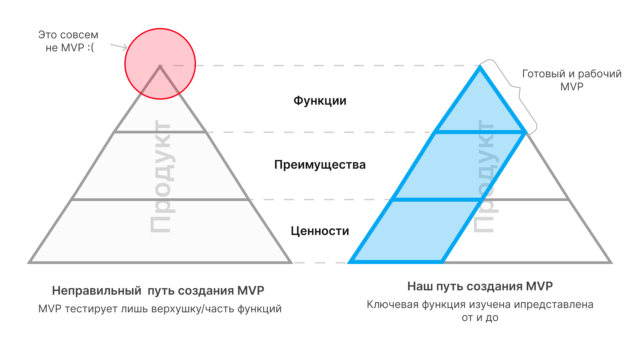
Why is this important?
According to CB Insights data, 38% of new products close because they are simply not needed by the market. Another 35% do so because their funds run out. These reasons are almost always connected: companies try to build the "perfect" startup, spending time and budget, only to find later that the market isn't ready. The examples are straightforward and illustrative. Dropbox started with a short demo video where founder Drew Houston merely showed how files were synchronized. The actual product didn't even exist yet, but people began massively leaving applications. Airbnb kicked off with a couple-page website designed to rent out a regular mattress in an apartment. No complicated integrations, just a basic function of "list accommodation — book accommodation." Instagram entered the market solely with photos and filters — enough to hook users. Success doesn't lie in guessing dozens of features, but rather in swiftly testing one.
The goal of an MVP is to achieve product-market fit. This moment occurs when the product aligns perfectly with market demands, users return voluntarily, customers pay and recommend it to others. Demand grows faster than the team manages to add features. Marc Andreessen said: "When there's product-market fit, the market pulls the product faster than the company can improve it." Conversely, if product-market fit is absent, no marketing efforts can help. You may spend thousands on advertising, but the money will go to waste.
Why exactly 90 days?
A deadline motivates discipline and prevents businesses from getting lost in endless cycles of "let's also include this." In three months, it's possible to complete the full cycle: the first two weeks are spent on analytics, problem interviews, and hypothesis formation. Then comes the design of processes and user scenarios. From week five to eight, the focus shifts to developing the base functionality and integrations. On week nine, the product launches to a limited audience. The final two weeks are dedicated to gathering feedback and making adjustments. Such rhythm allows fixing results and avoiding project delays over years.
At Sailet, we use a clear methodology tested in accelerators and real-world projects. We build everything modularly, show progress every two weeks via personal account and demos, remove all unnecessary elements, and leave only what truly tests the hypothesis.
Example: One corporate client wanted to create a learning platform with dozens of roles, reports, and integrations. We narrowed it down to one single function: "employee logs in — sees lesson — completes it — result gets recorded by HR." That was sufficient to validate demand. Result: 400 registered users within the first month and initial sales. In another case, we reduced an idea from 12 features to just one — discovering that it provided 80% of the user's value.
To grasp the difference, compare traditional development with the approach of "MVP in 90 days." Classic model takes 12–18 months and requires a budget of $200–500 thousand. The risk of losing money here is maximum: you first write code, then enter the market hoping it awaits you. Our method offers a cycle lasting only 3 months, a budget 3–5 times smaller, minimal risks, and validation starts directly from the market, not from the code. It's fairer and more profitable.
It's essential to realize that we don't work with startups without funding. If an entrepreneur has no capital, it's better to experiment independently, gaining experience along the way. However, if there are available funds, the main value lies in saving time and focusing on business growth by delegating development tasks to a professional team.
If you want to verify your idea and quickly bring your product to your clients, come to us. We'll help you launch an MVP in three months and demonstrate to investors, partners, and the market that your project works.



 English
  Русский
  Қазақ тілі
  Español