


Your Business is Growing. But Your Systems Aren't.
At some point, a company stops being managed ad hoc. And Excel, Bitrix, Telegram, and 1C turn from helpers into chaoswhich drags profits down.
Owners usually feel it like this:
— numbers don't add up;
— employees work based on their feelings;
— decisions are made blindly;
— manual data entry eats up people and margins;
— control equals manual pain.
Today, the architecture of 90% of companies at the Growth Stage (30–500 employees) looks like this:
- 1С — for money
- Bitrix/AMO/custom solution — for sales
- Excel — for management accounts
- Telegram/WhatsApp — for communication
- Custom-made mess — for operations
- Google Sheets — for reports
- Manager Reports — to try to match reality somehow
This isn't an architecture. This is — patchesthat pull in different directions.
14 Signs That a Company Has Outgrown Its IT Environment
Check the boxes — if you have 5+ signs, you're already in the risk zone:
- Reports are compiled manually → takes more than 2 hours per day.
- Data in CRM ≠ Data in 1C.
- Managers work "the way they are used to," not according to process.
- Telegram is the main management tool.
- Excel has become an ERP system ↔ half of the company's processes rely on it.
- The company has more than 3 systems that are not interconnected.
- Duplicate data.
- It's impossible to know the actual figures "right now" — only "tomorrow."
- Implementation of any new feature = 2 months of chaos.
- Employees make mistakes → money is lost.
- You're hiring "additional staff" to cover manual tasks.
- Each new branch creates its own tables.
- A manager needs a separate person "to consolidate reports."
- Scaling scares because the current system will break.
If there are 8+ signs, you're losing money daily, but you're unaware of it.
Where exactly is money being lost?
1. Manual data entry
A manager enters the same information into 2–3 systems.
Cost of error → from 5–50 thousand tenge per incident.
Monthly losses amount to 2–3 million tenge.
2. Fabricated reports
Every manager calculates "in his own way."
Result: Management decisions → made blindly.
Losses: Margin decreases by 5–12%.
3. Human Error
— Forgot to call back
— Sent the wrong invoice
— did not close the task
— lost a client
Losses: up to 10% of revenue.
4. Inability to scale
After reaching 30–70 employees, processes break down.
The company hits an IT glass ceiling.

Chaos is not caused by people; it's in architecture.
Business grows faster than its IT foundation.
Here's the dead end that almost every company ends up facing:
- the number of employees has increased;
- processes have expanded;
- data flow has grown;
- load has increased;
- but the system remains the same.
It's like trying to open a second branch using the same Excel spreadsheet from 2017.
What should be instead of “Zoo”
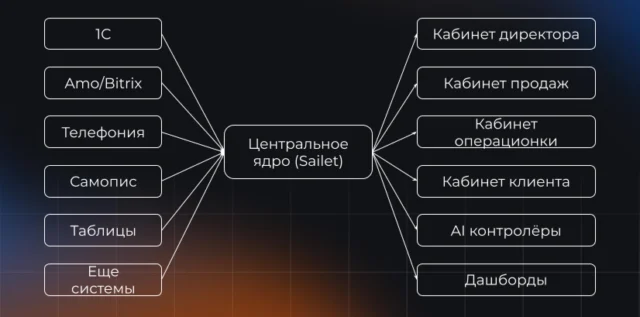
The right model is — Unified digital systemwhich includes:
- Single window for employees and management.
- Integrations with 1C, CRM, banks, telephony.
- Rigid processesbuilt into interfaces.
- AI controlthat prevents mistakes.
- Role-based model — each person sees only what they need.
- Director's dashboard — real-time figures.
- Architecture ready for a 10-fold growth.
This is the difference between a patchwork quilt and a system.
One system. One logic. One truth in numbers.
Effect of "United System" in Numbers
Based on Sailet case studies:
- Reduction of losses due to human factor — 30–70%
- Speed of managerial decision-making — ×10
- Reduction of workload on personnel — 20–40%
- Reduction of monitoring costs — up to 6 million tenge per year
- Increase in sales conversion — 12–25%
- Zero dependence on employee memory
And most importantly: the business stops operating manually.

When should you transition to a Unified System?
- Report discrepancies
The CEO receives two different answers to the same question. - Company growth
A doubling of operations is planned — current systems will not be able to handle it. - Change in management team
Knowledge needs to be transferred from people's heads into the system. - Departure of key employees
Business shouldn't rely on one person. - Investors demand transparency
They need a process, not chaos. - The company is losing customers.
Due to errors and lack of systematic approach.
How does Sailet solve this problem?
We are building neither a "website" nor a "CRM."
We are building a company's digital backbone..
Enters:
- Process audit
- Data architecture
- Prototypes
- "Single window"
- Integrations with all services
- AI control
- High-load infrastructure
- Support and development
- Access to project Dashboard ("Aquarium")
You don't just get software, but rather bringing order.
Want to understand what state your system is currently in?
Sailet will conduct express diagnosis of the IT landscape of your company:
— identify money leaks
— assess the scale of chaos
— show an architectural solution plan
— provide cost and ROI forecast
This service is free for companies with revenue of from 30 million tenge per month.
Submit an application. Next steps based on numbers.



 English
  Русский
  Қазақ тілі
  Español